
Price range: £15.00 through £20.00
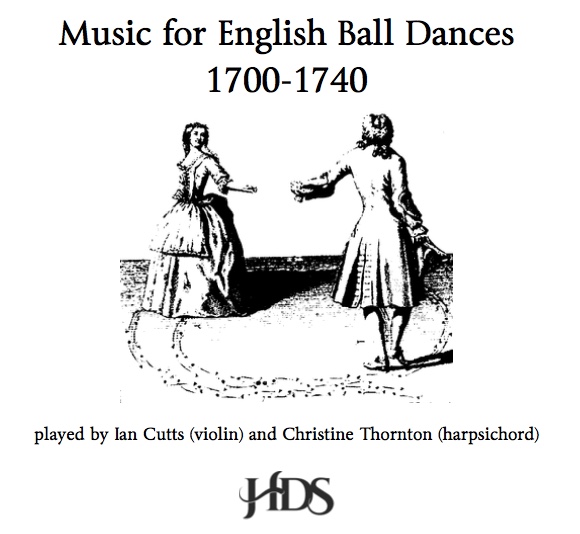
The style of dance known today as baroque dance, or French noble style, flourished in England in the late seventeenth and early eighteenth centuries, where it was referred to as “French dancing”. The publication in 1700 of the Beauchamp-Feuillet system of dance notation resulted in the preservation of many dances, in print or manuscript, and this, together with some important treatises, has made it possible for present-day dancers to reconstruct and perform them. Of the 340 or more surviving choreographies in this notation system, around 90 were created by dancing masters working in England – either English by birth or by adoption. Some were created for the stage, some to demonstrate the achievements of the masters’ students, but the majority were for performance at balls held at court, or in other aristocratic or genteel situations, or at public assemblies. The great majority of these ball dances are to be danced by one couple, man and woman, dancing in front of spectators. A few are for a single woman or girl. Although the ball dances avoid the more virtuosic steps found in stage dances, they nonetheless require much training and practice.
Released in 2022, this recording makes available the music for all English ball dances surviving in notation, for the use of performers, teachers and students of baroque dance.
The recordings are presented in groups corresponding to the various dancing masters who created the dances. The composers of the tunes are given if known, along with the sources of original arrangements where they exist. All tracks have been dance-trialled.
The 2-CD set is accompanied by a 6-page booklet giving full details of the music sources and links to the dance notations where these are available online. Some others are available in modern republications, as noted under each entry. The originals are held in various libraries, chiefly the British Library, the Bodleian Library, the Library of Congress, the Vaughan Williams Memorial Library and the Bibliothèque nationale de France.
Each dance has its specific tune, printed in the source above the dance notation (melody only). In many cases, bass lines or keyboard arrangements have been found in contemporary sources, and these have been used in the recordings. In the remaining cases, arrangements have been supplied by the players. In a few cases, two alternative tunes existed for the same dance, and both are included here.
Music on the recordings is played by:
Ian Cutts – violin by Corrie Schrijver 2009, after Robert Cuthbert 1676
Christine Thornton – harpsichords by Christopher Barlow, after Giovanni Baffo c.1574 (Isaac dances) and by Colin Booth (remainder)
Note that if the digital option is selected, the tracks are supplied in mp3 format and the booklet in pdf format.
Tracks:
DISC ONE
1 The Favorite (dance by Mr Isaac)
2 The Royall Gailliarde (dance by Mr Isaac)
3 The Rondeau (dance by Mr Isaac)
4 The Northumberland (dance by Mr Isaac)
5 The Richmond (dance by Mr Isaac)
6 The Rigaudon (dance by P. Siris)
7 The Rigadoon (dance by John Weaver)
8 The Gloucester (dance by Mr Isaac)
9 The Princess (dance by Mr Isaac)
10 The Spanheim (dance by Mr Isaac)
11 The New Spanheim (dance by Mr Isaac)
12 The Marlborough (dance by Mr Isaac)
13 The Britannia (dance by Mr Isaac)
14 The Union (dance by Mr Isaac)
15 The Saltarella (dance by Mr Isaac)
16 The Royal Portuguez (dance by Mr Isaac)
17 A Chacone (dance by Mr Isaac)
18 The Rigadoon Royal (dance by Mr Isaac)
19 The Royall (dance by Mr Isaac)
20 The Royall Ann (dance by Mr Isaac)
21 The Pastorall (dance by Mr Isaac)
22 The Godolphin (dance by Mr Isaac)
23 The Friendship (dance by Mr Isaac)
24 The Morris (dance by Mr Isaac)
25 La Camilla (dance by P. Siris)
26 The Brawl of Audenarde (dance by P. Siris)
27 The New Englich Passepied (dance by P. Siris)
28 The Siciliana (dance by P. Siris)
29 The Diana (dance by P. Siris)
DISC TWO
1 The Montaigu (dance by F. Le Roussau)
2 The Dutches (dance by F. Le Roussau)
3 The Two Virgins (dance by F. Le Roussau)
4 The Villette (dance by F. Le Roussau)
5 The Passepied Round O (dance by Kellom Tomlinson)
6 The Shepherdes (dance by Kellom Tomlinson)
7 The Submission (dance by Kellom Tomlinson)
8 The Prince Eugene (dance by Kellom Tomlinson)
9 The Address (dance by Kellom Tomlinson)
10 The Gavot (dance by Kellom Tomlinson)
11 Minuet in D (dance by Kellom Tomlinson)
12 Minuet in A (dance by Kellom Tomlinson)
13 The Princess Royal (dance by Anthony L’Abbé)
14 The Princess Anna (dance by Anthony L’Abbé)
15 The Royal George (dance by Anthony L’Abbé)
16 New Royal George (dance by Anthony L’Abbé)
17 The Princess Amelia (dance by Anthony L’Abbé)
18 The Princess Ann’s Chaconne (dance by Anthony L’Abbé)
19 The Prince William (i) (dance by Anthony L’Abbé)
20 The Prince William (ii) (alternative tune)
21 The New Rigodon (dance by Anthony L’Abbé)
22 The Canary (dance by Anthony L’Abbé)
23 Prince Frederick (dance by Anthony L’Abbé)
24 The Prince of Wales (dance by Anthony L’Abbé)
25 Queen Caroline (dance by Anthony L’Abbé)
26 The Prince of Wales’s Saraband (dance by Anthony L’Abbé)
27 The Prince of Orange (dance by Anthony L’Abbé)
28 The Princess Passpie (dance by John Essex)
29 La Cybelline (anonymous dancing master)
30 Le Rigaudon Renouvele (dance by William Holt)
31 The Prim Rose (dance by Mr Marcelle)
32 The Slow Minuet (dance by Thomas Caverley, Edmund Pemberton version of tune)
33 The Slow Minuet (Kellom Tomlinson version of tune)
34 The Princess of Hesse (dance by Leach Glover)
All rights reserved; public performance or broadcasting without permission is prohibited. When used for teaching, recognition must be given to The Historical Dance Society. ℗ & © 2022 The Historical Dance Society
Related products
-
 Select options This product has multiple variants. The options may be chosen on the product page
Dances for Queen Victoria – book with 2 CDs
£30.00 -
 Add to basket
Dances of Court and Country – CD
£10.00 -
 Select options This product has multiple variants. The options may be chosen on the product page
Boone Companion – CD
£10.00